| The Dowdall eviction.
John Walter Dowdall died in 1885 and willed his Bellhill home and farm to his two sons, Patrick and Thomas. His wife Bessy Marmion appears to have predeceased him. The previous years had been a turbulent time in Irish politics witnessing very bad harvests in the late 1870s and a land war between tenant farmers and landlords. Charles Stewart Parnell and his Irish Parliamentary Party had argued the tenants’ case in the Westminster Parliament and had succeeded, under Prime Minister Gladstone, in having a number of land acts passed. The 1881 act established the Land Commission and a Land Commission Court. Tenants could now enter the court and plead for a reduction of their rent; in almost every case it was granted. In Mourne reductions averaged 20%. After the passing of a further fifteen years tenants were free to plead another reduction. The landlords, to all intents and purposes, were ‘finished’. The Dowdall brothers possessing 129 acres, 2 roods, 22 perches, could scarcely be considered as in the landlord class, most of whom held thousands of acres but by 1889 they were in financial difficulty and the Land Acts were partially to blame. In that year Mr. Hunter Moore, solicitor and agent for W.F. Thompson of Dublin who held the townland of Ballyardle sought to evict the brothers for non payment of rent. The application was heard and a decree for eviction issued. The brothers did not appear in court nor did they appoint anyone to defend them. Why they did not do so is difficult to say; perhaps a sense of shame or a belief that Moore had no case may have prompted them to stay away. In any event they were extremely foolish for a writ of eviction once issued was well nigh impossible to overturn. Moore who was also the agent for the Kilmorey estate was an expert in land law and well known in the courts. Patrick and Thomas were shocked and the judgement was a topic of conversation in every household in Mourne. While the oral tradition holds that the brothers were not necessarily the most efficient of farmers no one ever expected them to be evicted. The sheriff and bailiffs together with Royal Irish Constabulary back up, as was the custom, arrived on the 26th November 1889 and the brothers were ejected. Curious neighbours gathered to watch the proceedings as all the furniture was carried out and left on the roadside; doors were locked and gates barred. The brothers put up no resistance and left quietly; tradition has it that the Nicholsons of Ballymagart mill stored their furniture until such times as they could find a home for it or dispose of what they did not need. A period of some months had passed since the issuing of the degree and Patrick who was regarded as a confirmed batchelor, fearing the worst, did the unthinkable and found himself a wife. He was married in St. Joseph’s Church, Caledon, Co. Armagh, on June 19th 1889 to Miss Margaret McSherry. The witnesses were John William Keating and Bridget McLarnon. He was forty years of age. Margaret lived in a fine property at No. 28 in the Main Street. Thomas followed his bother to Caledon and lodged with him for some time. He bought a jaunting car and ferried passengers to and from Caledon railway station. In 1894 Margaret Dowdall bought a farm of just over twenty acres at College Hall (the land belonged to Trinity College, Dublin), also known as Marresset, and with Patrick by her side she settled down to farming life. Nothing more was officially heard of the eviction until after the passing of the Wyndham Land Act of 1903. This act contained a clause which made provision for evicted tenants, in certain circumstances, to be reinstated in their property. It was closely followed by the Evicted Tenants Act in 1907. In March 1904 Patrick and Thomas began a long and at times acrimonious correspondence with the Land Commissioners. It was to last, on and off, until 1927, the last letter being received in March of that year. Thomas, who was the least articulate of the two, wrote most of the letters. Patrick was more circumspect in the language he used while Thomas stated his case quite bluntly and told it exactly as he saw it. The brothers’ argument was quite simple; as they perceived it, they were cheated out of their property by the machinations of the agent, Hunter Moore and his sub-agent John Annett. They were asking for two things, an inquiry into what happened and reinstatement in their property. In Patrick’s first letter he explained how they found themselves in the financial predicament which led to the eviction. In Patrick’s words, ‘The farm in question never got the benefits of any of the land acts, but the rent was raised three times during my day, and I am not yet up to the span. It was for a £60 of an annual rent of £81.12.8 or in fact for one half years rent of the above description, and on the strength of which, the agent served the eviction notices, which severed our title to our piece of property. Owing to the circumstances (also the agent’s particular creation) we could not redeem within six months. This the agent brought about, the way he could become the owner. You see he was reared in the next townland, he was a solicitor, and it was his district, indeed I will try to explain further. My grandfather (by my mother) Marmion, purchased the holding about the middle of the 17th century (Note: this should have read 18th.) at a rent of 15/1 (note: fifteen shillings, one penny, just over 75p in to-day’s currency) per Irish acre. A lease in perpetuity, which continued up to his death, but soon after, by the most skilful intrigue and fraud on the part of the rent office, the lease was broken, and up went the rent on the widow Marmion to £1.3.1 per Irish acre or eight shillings per acre of a rise ----- my father got twenty acres of the farm through marriage to my mother and bought the remainder from his mother in law, widow Marmion, at the foolish price of £40 per Irish acre, and spent half as much on some acres in improvements, as he was well of at the start. He also got a long lease granted to him, which continued on up through the eighties, which lease bared (sic) us from the benefits of the land acts. The holding in question comprised about 115 statute acres, one half of which was let to sub tenants. They got their rent reduced in 1882, by less than what we were paying for their paid holdings, to our landlady Mrs. Thompson. This explains rise the second. Then again in ’87 they got the benefit of the automatic reduction of 3/6 in the £, or in both about 25% less, they were paying to us, for their farms, than we were paying for their said farms to Mrs. Thompson. This is the third rise I mention above, and I hope it explains the nature of the holding. It was for the rent that actually accrued during ’87, and nine £ of arrears, total £90.12.8 that the agent took proceedings for. “The case being undefended and the judge being misled, not knowing a particle of the case, gave them a decree, but put a stay on for three months but in less than one month, the agent interfered, and prevented the (to us unfortunate) sub tenants in paying us £30.12.8 which they fair and lawfully owed us before proceedings were taken at all. If the agent had law, for stopping this £30 odd we in simple practice or justice, had a right to credit for it as £30 cash paid, balance due £60. Now as £60 is not a year’s rent of a farm which is £81.12. 8 what can it be called?’ Patrick goes on to explain that Moore offered him £200 for his farm in April ’89 but that £2000 had been offered for the same ‘early in my day’. In the year following the eviction by an indenture of Fee Farm Grant dated 19th February 1890 William Francis Thompson of Dublin granted to Robert Annett and James Annett both of Ballykeel, for the sum of £200 and at the yearly rent of £55, 59 acres, 3 roods and 33 perches, statute measure, with all houses and buildings. Some of the houses comprised the homes of under tenants named as Mary Morgan, Ellen Magee, Mary Magee, Margaret Scharlett and Thomas Doyle. This farm was almost half of the Dowdall holding. The two brothers belonged to the family of Hunter Moore’s sub-agent John Annett. Following the conviction of this man at the Down Assizes in 1904 for the embezzlement of £6.17.6 the Dowdall brothers alleged that he had withheld a sum of rent which they had paid him and he failed to pass on to Hunter Moore. No evidence was ever produced to substantiate the allegation. Over the next twenty years three members of parliament, two at Westminster and one at Stormont, were to raise the matter but to no avail. Jeremiah McVeagh M.P., raised it with the Lord Lieutenant of Ireland in 1912, Joe Devlin M.P., brought it forward in 1926 and P. O’Neill M.P., from Warrenpoint, raised it with the Land Purchase Commission in 1929. He was informed that in 1912 the Land Commissioners had ‘decided that the case was one in which they should take no further interest’. The Commission maintained that the sum of rent owed by the brothers was greater than they claimed. One inspector’s report stated the amount owing was £213.17.10 but a note in another hand beside this figure suggests, ‘some of this may have been costs’. Over the years various solutions had been sought or suggested. In the early years the brothers insisted they would accept nothing less than reinstatement in the family farm. The Annetts at one stage added to the house in an attempt to block re-entry. They also demolished a number of houses including the large house occupied by Rose Marmion but belonging to the Dowdall brothers. Rose, who was in her nineties, appears to have gone to live with a Quinn family in Dunavil. Patrick Dowdall accused Annett of carrying away hundreds of tons of building material. As it became obvious that the Dowdalls were unlikely ever to get their old home back it was suggested that they might be given a farm of similar size. Some commissioners were sympathetic to this idea others argued that the brothers were too old to handle such a farm and any how Patrick was very comfortably off in Caledon. Thomas had moved out of Patrick’s home and was lodging in a room above a pub in the town. Patrick at one stage suggested that they be given a farm in the County Meath as his father was a Meath man and belonged to the Dowdall family who once owned Athlumney Castle at Navan in that county. This castle and lands had been confiscated following the Williamite wars. If only the brothers had offered a defence when the decree of eviction was first sought things might have been quite different. The last of the ‘Magenis of Ballella’ family. In 1882 Miss Anna Magenis of Ballella died. At her funeral the officiating priest described her as ‘descended from a Royal and Princely family, who gave kings, statesmen, warriors and chieftains, priests, abbots, and bishops to this country and her Church’. She was the last surviving child of Roger Magenis, brother of John and Rowland and neice of Jane and Charity (Mary) Marmion. Her father who had married Anna Letitia Magenis in 1804, died in 1815. The children of this marriage were Roger, John, Jane, Mary and Anna. None of them married. Roger who was quite young when his father died inherited Ballella house and estate. He died in 1872 leaving every thing to Anna. She in turned willed the entire estate to Monsignor William McCartan, parish priest of Dromore and Garvaghy, upon certain trusts. The will also contained a clause which stated that if anyone challenged its contents the estate became the property of the parish priest, ‘absolutely’. A Mrs. Anna Gordon, of Belfast, claiming to be a cousin of Anna Magenis, lodged an objection. No one who had been close to Anna knew this lady and if there was a relationship it must have been quite distant. Following the challenge Monsignor McCartan’s solicitor sought the advice of Mr. Dobbs Q.C., later Judge Dobbs, who stated that the property now belonged to the Monsignor. Anna had wanted the house and land to be used by some religious institution. In 1883 the house was sold by the parish priest to the Jesuits who were hoping to establish a college. It appears there was some Diocesan resistance to this since such a college might inhibit the growth of St. Colman’s, the Diocesan Seminary. In the circumstances the Monsignor bought back the property. The parish priest died in 1907 and willed the lands of Ballella to Bishop O’Neill of Dromore and Archbishop Logue of Armagh to be used as a home for superannuated priests. Before his death he agreed the sale of the lands to the Land Commission for the sum of £5044. In February of 1917 an action was initiated in the Chancery Division, Dublin, by the Commissioners of Charitable Donations and Bequests. The defendants were the executors of the wills of Anna Magenis and Monsignor McCartan. They were joined by Cardinal Logue, a surviving trustee of the will of Monsignor McCartan and Thomas Dowdall as one of the next of kin. The plaintiffs sought to have the trusts, those that were valid, of the will of Anna Magenis put into effect and if necessary to have the personal estate of Monsignor McCartan administered by the court. The plaintiffs held that the Monsignor had not carried out the trusts imposed on him. The defendant Thomas Dowdall submitted on behalf of the next of kin that on the death of the Monsignor certain properties became the undisposed assets of Miss Magenis and should go to the next of kin. Prior to the court hearing Mr. Hugh Hayes, solicitor, had carried out a lengthy investigation into the title to the property. At one juncture advertisements were placed in Liverpool, Glasgow and Irish newspapers inviting anyone who thought they might have a claim to contact him. He was told by Father McEvoy of Dromore that ‘there had been rumours in Ballella that the Magenis’s had cousins working as labourers in Liverpool whom it was said were the lawful owners of Ballella were it not for the will of Anna Magenis’. This was obviously a reference to the Marmions. Patrick Dowdall submitted a claim as did his half brother James Murphy, merchant, of Sugar Island, Newry. Many claimants came forward but no Marmions. Hayes stated, ‘I came to the conclusion on going through the several claims that Patrick Dowdall’s was the clearest’. The Magenis American cousins appear to have been totally forgotten. A lady contacted Hayes to say that the last of the Magenis line had drowned in Belfast Lough and while the investigator wrote back asking for precise dates and names, no reply has been found. Was this Bartle? Anna had stated in her will that if the finances of the estate permitted the Monsignor should assist her cousins Rose Marmion, Anne Wilson, Mrs. McDevitt and Bartle Magenis. Bartle was the grandson of John of ’98 fame being the son of Bartholomew Teeling Magenis who had emigrated to America around 1849. Before leaving Ireland he had left his youngest son, Bartle, in the care of his sister Eliza who had married in 1847, Neal Phebus McDevitt, journalist with the Vindicator newspaper and later the Freeman’s Journal. Rose Marmion of Ballyardle and Anne Wilson had lived with Anna at Ballella for some years previous to her death. They were now dead and it appears so were Mrs. Eliza McDevitt and Bartle Magenis. Patrick Dowdall who had been informed that his claim was the best founded was to be sorely disappointed. Having been evicted from his property, illegally, as he believed, he must have felt that at last Lady Luck was beginning to smile on him. This however was not to be the case for while the court ruled that the trusts of the will for the establishing of a monastery or other religious, ecclesiastical, or charitable institution were invalid it also ruled that the residuary real and personal estate went over to the Monsignor absolutely. The next of kin had no entitlement. This was a major ruling and had implications for anyone considering leaving property or wealth to the church. This particular piece of legislation had long been a concern to the Catholic Church. The Marmion family of Lurganconnery and Dundalk. In 1825 James Marmion sold (see above), his half of the Lurganconary farm to Robert Davidson of Cranfield. In the following year Robert bought the other half from the Marmion family of Dundalk. The deed of conveyance was agreed between, 1 Margaret Marmion otherwise Coleman of Dundalk --- widow of William Marmion late of Dundalk, deceased and 2 The Rev. John Marmion of Maynooth in the County of Kildare and eldest son of William and Margaret Marmion and 3 Richard Marmion of Dundalk ---- the second son of William and Margaret and 4 Thomas Marmion of Dundalk – the third son of William and Margaret and 5 Elizabeth Marmion of Dundalk – spinster – the only daughter of William and Margaret and 6 Robert Davidson of Cranfield. 7 The family conveyed to Robert the lands of Lurganconary containing thirty acres, one rood and four perches --- formerly in the possession of Patrick Marmion deceased and afterwards in the possession of William Marmion deceased -- for the remaining lives of Charles Lewis and Peter Doran and the residue of a term of forty one years – subject to the payment of a moiety of the rent. Margaret also exonerated the lands from the payment of a jointure or annuity contained in her marriage settlement and her daughter Elizabeth also freed the lands from payment of her share of £300 and the payment of a further £100 mentioned in the will of William Marmion. The deed was witnessed by Charles McMahon and Joseph Coleman. James and William who owned the Lurganconary property appear several times, in the in the late 1700s, in lists of linen drapers published in the Belfast Newsletter. They may have been brothers or uncle and nephew. The original lease, of October 1793, was in the names of Patrick and James. As witnessed above William succeeded Patrick and by 1826 William was also deceased. William sometime in the late 1790s has married into the well known family of Coleman of Dundalk and linked his marriage settlement to the Lurganconary farm. He has quit the farm and opened a business in Dundalk sometime before 1822 for in a commercial directory of 1820-22 he is listed as a ‘Spirit and Porter Dealer’ carrying on business in the Upper Ward. He married Margaret Coleman. Having called one of her children Thomas she may well be the daughter of the Thomas Patrick Coleman, tanner, who took a lease, in 1788, on premises at No. 98 Park Street. A Mrs. Marmion, presumably Margaret, is listed in 1837, as living at No 100 Park Street; next door at No. 99 is Richard and below him Thomas and a Thomas Coleman. Thomas Marmion died in 1856 and was laid to rest ‘at the family burial ground of Louth’. This would appear to be the village of Louth and may provide a clue as to where the Mourne Marmions originated. He was involved, with his cousin Thomas Coleman, in the tannery business. The Coleman family played an important role in Dundalk business life. They are listed as Tallow Chandlers and Soap Boilers, Linen and Woollen Drapers and Tanners and Curriers; Patrick is a physician and Neal a merchant. Interestingly, not only are the Marmions, Colemans and Murphys linked through marriage but they are also linked business wise being heavily involved in the tanning and soap making business. William and Margaret’s daughter Elizabeth married into the Boylan family of Kilpatrick and Blakestown, County Louth. In the marriage settlement agreed in December 1834 Elizabeth’s future husband Patrick lists his properties and entitlements and her mother, Margaret, pledges £1850, £1000 of which is to constitute Eliza’s marriage portion. The agreement involved her brother, Father John Marmion, and was witnessed by her other brother Thomas together with her cousin Thomas Coleman. This branch of the Marmion family had obviously prospered in Dundalk. Father John was ordained at Maynooth College, for the diocese of Armagh in 1825. Strangely, he is listed in the O’Fiaich Memorial Library as being head of the Classical and Mercantile Academy, Dundalk for the years 1823 to 1827, two years prior to his ordination. The fact that he was ordained for Armagh and not the diocese of Down and Connor would indicate that the family was resident in Dundalk when he commenced his studies. From 1828 to 1838 he was curate at Dundalk and from 1839 to 1870 he was parish priest of Haggardstown and Kilkerly. He died on the 12th December of that year and was buried at Louth cemetery. During the Famine he was a member of the Haggardstown Relief Committee and for thirty years was chaplain to the Dundalk Union workhouse. In 1851 he opposed abuses in rent collection and evictions by the Foster family, one of the most important families in County Louth. On the 15th December 1833 the new Catholic Church of St. Colman outside Kilkeel was consecrated by the Rt. Rev. Dr. Crolly, bishop of the diocese of Down and Connor. This T-shaped church, replaced the older building opened in 1818, which by the 1830s would have been unable to accommodate the burgeoning congregation. At the opening the church was packed to capacity and contained not only the Catholics but also, ‘—all the respectable Protestant and Presbyterian gentry of the surrounding country’. The report in the Newry Examiner goes on to relate the sermon preached by the Rev. J. Marmion, curate of Dundalk, and the deep impression it created on all who heard it. On first reading this report it seemed surprising that a curate from another diocese should be invited, on such an occasion, to preach a sermon in front of Bishop Crolly. Only on discovery of the above document did the links of Rev. John Marmion and St. Colman’s become apparent. Father John was a Mourne man, born in Lurganconary, and related to Patrick and Richard Marmon (sic) who in 1779 acquired the site for the first Catholic church to be built in the parish of Upper Mourne since the Reformation. The new church was built by voluntary labour and at a time when the congregation would have been facing considerable economic hardship. Catholic families of substance, the Marmions included, would have been called upon to help defray the costs. Inviting Father John to preach was in some ways an acknowledgement of the role the family played. Father Marmion died on the 12th December 1870 and was buried in Louth cemetery as was his brother Thomas Marmion (above). Later Marmions of Lurganreagh and Grange. Patrick Marmion of Lurganreagh died in 1865 ‘far advanced in years’ according to his will. His wife Elizabeth’s death is recorded on a tombstone in Massforth cemetery; she died in 1853 aged 66 years. Patrick would have been born probably in the 1770s. His will lists six children, others may have died. William, the eldest, lived in Ballindolty, Killowen a few miles outside Kilkeel. He and his wife had no family. John lived in Grange and his other son Pat in Lurganreagh. Four daughters are listed, Catherine who married McGivern, Mary who married Byrne of Cranfield, Alice who married Mackin of Dunavil and Elizabeth who married Livingstone. John of Grange who married Elizabeth Sloan died in 1891 aged 69 years; they had ten children. John (later Sir John) born 1855, Elizabeth born 1857, Alice born 1859, William born 1863, Peter born 1865, Margaret born 1867, James (later Canon James, P.P. of Dundrum) born 1870 and Henry (later a doctor in Edinburgh) born 1874. |
 |
| Members of this family, including at least three brothers moved to Liverpool. John, Patrick and Peter worked as stevedores on the docks. In the 1881 census John is listed as 26 years old and employing 300 stevedores. He was to take over the firm of Sir Thomas Houston and with his two brothers largely controlled the dock area. Considering the |
| amount of freight which passed through Liverpool in the late 1800s and early 1900s this was a vast undertaking and shows no mean entrepreneurial skill.
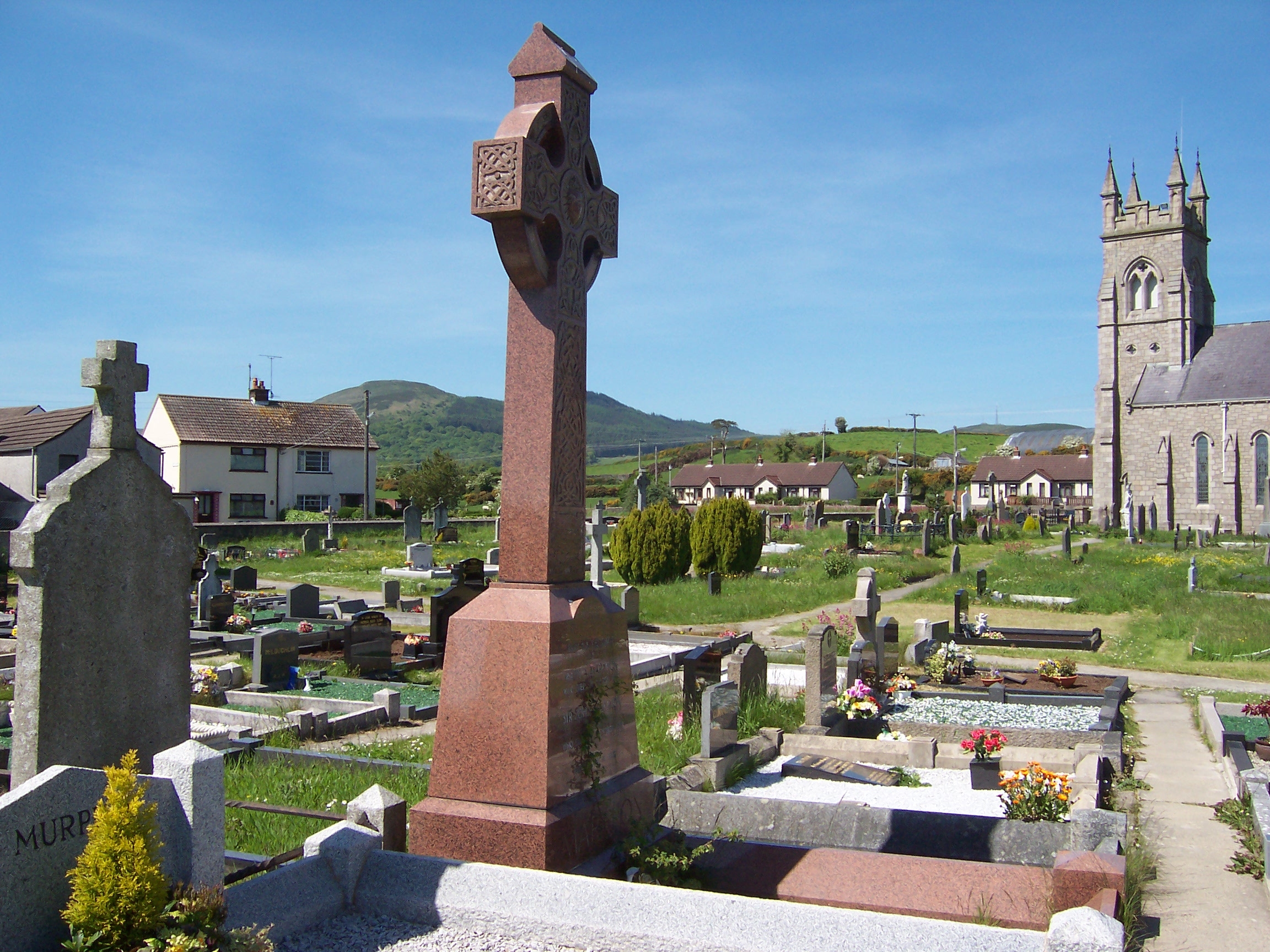
John controlled the Albert Dock, Peter that of Bootle and Patrick the ‘lighter’ business in the centre of the Mersey. Lighters were large open boats used for unloading ships. The work was labour intensive and dockers were hired daily at various designated points many of which were outside pubs. Dealing with ship captains was all important, good working relationships had to be established and this meant frequently entertaining and catering for their needs during the short time they were in port. Many Mourne men moved to Liverpool and worked for the brothers and while the work was tough the wages were good and much higher than they could obtain elsewhere. The vast majority of these men married and settled down and Liverpool to this day abounds with Mourne surnames; Sloans, Cunninghams, Dorans, Magees, Doyles and Marmions. Of course Mourne folk had been streaming into Liverpool since before the famine. Sailings from nearby Warrenpoint and later Greenore were regular and facilitated the crossing. John Hughes from Ballinran in Mourne would have been well known to the Marmions. He was born in 1858 and moved to Liverpool at an early age. By the time he retired in the 1920s he had built up a chain of over sixty very fine grocery shops in the greater Liverpool area. He also employed dozens of Mourne folk with many returning (Doyle, Magee, Murphy, Sloan, Trainor) to establish townland grocery shops. John Quinn of Tullyframe had been a ‘walking boss’ for Hughes, regularly visiting every shop; on his return to Ireland he founded the famous ‘Milestone’ chain. John Marmion, having amassed considerable wealth, bought back the old Marmion property in Lurganconary and having built a fine home decided to end his days in Mourne. He and his wife had no family; he died in 1938, aged eighty three years. Some years previously he had the title Knight Commander of St. Gregory conferred on him by the Pope He is best remembered for the building of the beautiful church of Our Lady of Lourdes on part of the home farm at Grange. John was the largest contributor and also erected the high altar. His wife provided one of the side-altars and his sister Margaret and brother Felix, erected the other. His mother had granted the site and his brother Peter commissioned the two beautiful stained glass windows in the sanctuary from the famous Clarke workshops, in North Frederick Street, Dublin. We should also bear in mind the contributions made by many Mourne people at home and abroad, too numerous to mention here. |
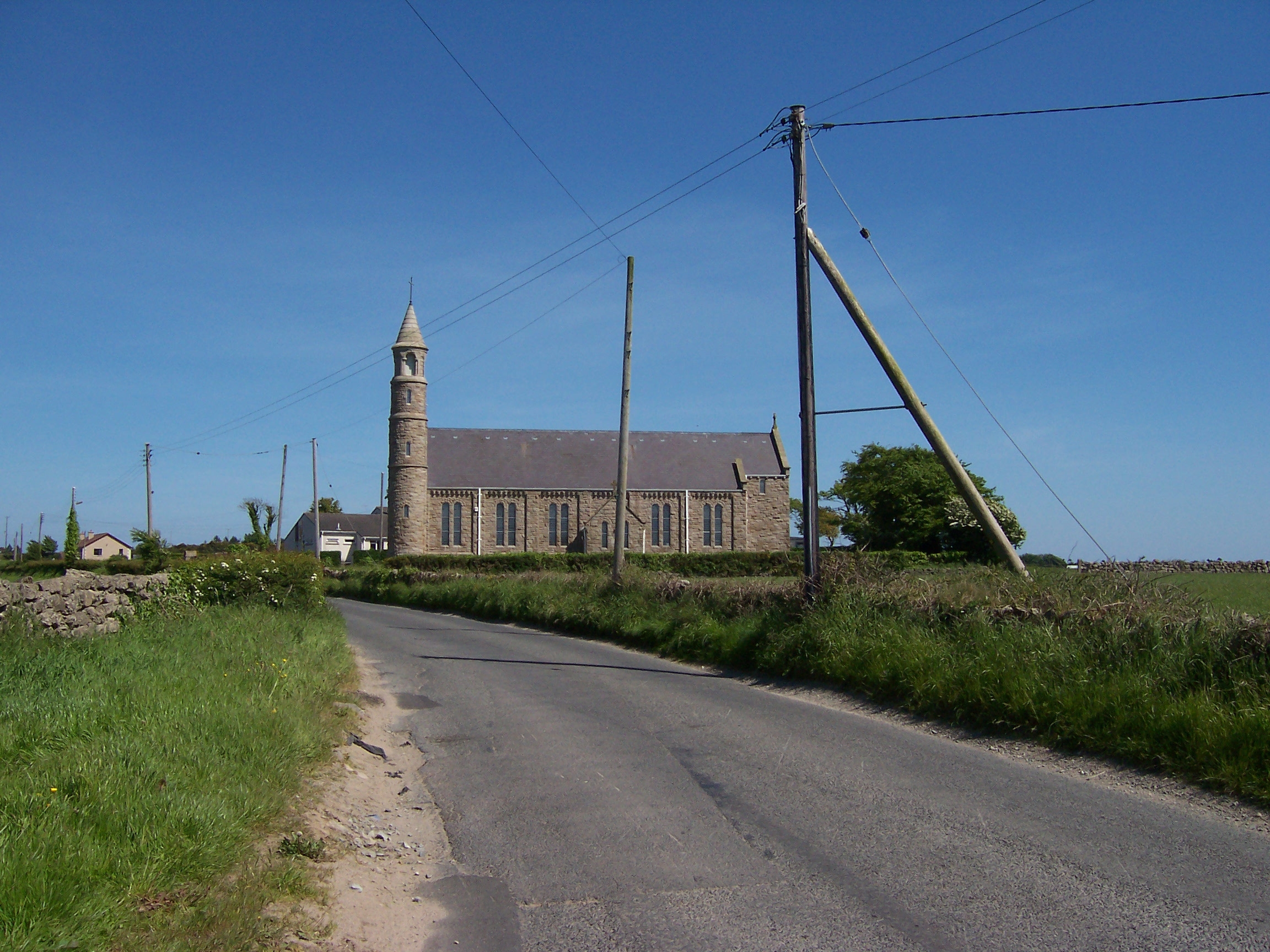 |
| The church of Our Lady of Lourdes, Grange. |
| above: The grave of Sir John Marmion, Massforth, with Celtic Cross.
The Marmion, Garvey connection. The family of Garvey according to the old Irish genealogies belonged to the territory of the Craobh Ruadh (the Red Branch) which comprised much of present day counties Antrim and Down. In the 1690s we find a daughter of Sir Christopher Garvey a maid of honour to the Spanish Queen. The family is also mentioned in a twelth century poem by John O’Dugan Dr. Anthony Garvey was appointed Bishop of Dromore on September 1st 1747 and died on the 24th August 1766. He was born in the townland of Aughnagun, the youngest son of Dudley and Bridget Garvey and apart from the years spent studying in Paris for his doctorate, he appears to have lived most of his life in this townland. In 1726 he was appointed Parish Priest of his native parish, Clonallon. He is buried in the family vault in St. Mary’s Cemetery, Newry. His will is a curious document not very well composed. It was written two days before his death and he was possibly quite ill when he wrote or dictated it. In it he mentions various members of his family but does not specify relationships. He refers to his sister Betty, to whom he leaves his [sitting] room furniture, but stipulates that John Garvey was not to be allowed into it, nor was John to meddle with affairs about the house or farm. Obviously John and he were not on the best of terms; he did however leave him his ‘second best shute of Close’. He leaves all the farm stock to Christy or Anthony until such times as they decide what to do with it. The largest item specified was the fifty pounds which was to go to the ‘two sons of Patt and Mary Marmon’. He also ordered Patt Marmon of Mor[ne] to collect all the rents and to give the tenants receipts in the name of Christy Garvey. There would appear to be a close relationship between the two families but we can only guess at the nature of it; Mary may have been a niece of the bishop’s. From the instructions contained in the will we can deduce that Christy and Anthony were not in a position to collect the rents but where were they? The farm the bishop occupied was leased to him in 1756 by Patrick Garvey of Aughnagon. It consisted of a dwelling house, office houses, gardens, orchards and the demesne containing about 85 plantation acres (approximately 130 statute acres) and was leased for a term of thirty one years at a rent of £16. Patrick may have been the bishop’s brother. Also in 1756 Patrick leased to John Garvey the Mountain Quarter of Aughnagon containing 61 plantation acres at a rent of £17.10. In a further lease of February 1768, a farm of 48 plantation acres was leased to Edward Murphy, Innholder, of Newry but this time by ‘Robert Garvey of Rowen (sic) in the Kingdom of France’. This Edward Murphy appears to have been the grandfather of the Catherine Murphy who married Arthur Marmion, but surprisingly he is leasing from a branch of the Garvey family resident in France. Anthony Garvey of Aughnagon signed and sealed the lease on behalf of Robert having been given ‘power of attorney’ to do so. How sizable was this branch and how long had they been living there? Some of the family may have fled to France following the defeat of the army of King James at the battle of the Boyne. Michael Garvey of Newry, Gent., is named in a list of Jacobite supporters for County Down. A list (twenty three names) of Newry burgesses for 1688, contains three Garveys; Michael Garvey an apothecary and Robert and Dudley both merchants. Newry which is quite close to Aughnagon was burned and largely destroyed in 1690. A deed of release registered in December 1802 records the conveyance of the townland of Aughnagon, containing 290 plantation acres (about 350 statute acres) by ‘James Edward Aloysius Garvey of Rouen in the Nation of France’ to Joseph Glenny of Dublin, Attorney at Law, ‘in his possession then being’. The deed contains no information as to Garvey’s title to the property, nor is a term of years specified but it does contain a redemption clause which is normally found in a deed of mortgage. This states that the deed ‘is subject --- to a condition of redemption upon payment of a sum of £455.11.8 with interest. The deed is entered in the Registry of Deeds and also enrolled in the High Court of Chancery. Surprisingly the deed is signed by virtue of power of attorney, on behalf of Garvey, by ‘James Marmion of Janebrook in the County of Down, Linen Draper’. Something of a mystery surrounds this townland of Aughnagon. The family of Garvey appears to have been in possession of this land through the penal era when the law relating to the ownership of land by Catholics was particularly harsh. Not only was it in their possession but they granted leases which also appear to have contravened the law, particularly in the amount of acreage they could lease to Catholics and the bishop resided on his farm, quite happily, at a time when the law stated no Catholic bishop should be resident in Ireland. The Rev.J. O’Laverty in his history of the Diocese of Down and Connor mentions the Garvey connection to Aughnagon. He states that about 1629 Hugh McCon McGlasny Magennisse mortgaged certain lands to Dudley Garvey of Newry and that this townland was possibly one of them. Whatever the truth of the matter the property would appear to have been in the family’s possession before the Williamite wars. A close study of this particular holding would repay any student of the penal laws! All of the above indicates a close family relationship between the Garveys and the Marmions. James Garvey of Rouen and James Marmion were probably cousins and possibly first cousins. The Garveys of Rouen and Thomas Jefferson. We do not know a great deal about the nature of the Garvey business in Rouen and what we do is gleaned from the correspondence of no less a person than Thomas Jefferson. During the years he spent as a diplomat in France, during the 1780s, Jefferson had various business dealings with ‘Mr. Garvey of Rouen’. He mentions these in his letters to Mrs. Abigail Adams. Not only was he purchasing wines from Garvey on his own behalf but he was also arranging for Garvey to convey goods to Mrs. Adams. These were purchases he had made for her in Paris, mainly bisque figures and finely decorated plates. The casual and familiar way he speaks of Garvey in his letters would indicate that Garvey was also known to Mrs. Adams and was someone whom they dealt with on a regular basis. Considering the close relationhip that existed between the Marmions and the Garveys there is a distinct possibility that some of the Marmion family may have gone to Rouen to work for the family. The name occurs in the city to-day and a trawl of the internet will show Marmions there in the 18th century. It has always been assumed that these were descendants of the ancient family of Marmion and no doubt some were. However when we discover the daughter (Marie Therese) of a Roger Daniel Marmion and Marie Millet dying in Rouen in 1752 it raises the possibility that ‘Roger Daniel’ may have been an Irishman. He might well be one of the thousands of Irishmen who fled to France after the defeat of the Irish supporters of King James in 1690. Family histories take strange twists and turns and there surely can be none stranger than the possibility that members of an old Irish Norman family, after being domiciled in Ireland for hundreds of years, sought refuge back in the place and country of their origin. A search of the internet will also show Garveys inter-marrying with the French aristocracy. Conclusion. The Marmion family appear to have arrived in Mourne from County Louth sometime in the eighteenth century. For two hundred years they played a prominent role in local affairs before dying out in the mid twentieth century. They were involved in the linen industry, in milling corn, scutching flax and paper manufacturing, in farming and in retail business in Kilkeel town. As Catholics they were very supportive of their faith and secured (as noted above) in 1779, the site of the first Catholic church to be built in the parish of Upper Mourne since the Reformation. This they did as soon as the law permitted Catholics to lease land for 999 years, although it took another forty years before the church was opened. To-day memories of the family are fast fading. A particularly restless family they were continually on the move, seeking to improve their lives. Families and individuals keep popping up in the records only to disappear again within a few years. Wherever opportunities arose to better themselves they moved to take advantage of them whether they were in America or latterly in Liverpool. John and his brother William appear to have been particularly attracted to their native home. Both retired from an active life abroad to die in Mourne; John from Liverpool and William from California where he had gone to work on the ranch of Henry Quinn from Aughnaloopy. He had two sons James Sloan Marmion and William Henry Marmion, both lived abroad. At no time within the two hundred year period they were in Mourne do they appear to have exceeded seven or eight families and yet their contribution to everyday life was considerable. Grange Church will always be linked to their memory and while it stands hopefully the family will not be forgotten. ©Tom Cunningham. 11.07.’06 |
 |
 |
 |
| Update on Dowdall Evictions- just found, click to enlarge, once enlarged click again to magnify |